
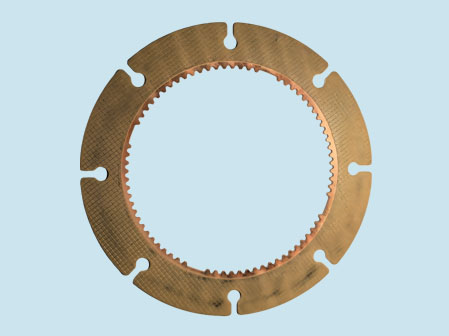
Copper-based sintered friction disc

Diamond friction pad
Product overview
Keywords:
- Product Description
-
- Product name: Diamond friction pad
1. Aviation field - fastening of precision components: suitable for aircraft engine accessory casings and navigation equipment connectors. With anti-vibration loosening and micron-level precision control, it can offset the risk of fastening failure caused by high-frequency vibration of the engine, while ensuring the installation coaxiality of navigation equipment to avoid accuracy deviations affecting flight data.
2. Wind power generation - main shaft and gearbox connection: used for the main shaft bearing seat of the wind power main engine, the connection between the gearbox and the nacelle. Under strong winds in the field and long-term alternating loads, the fastening pressure is maintained through long-term anti-loosening performance to prevent component displacement due to vibration. At the same time, high hardness is used to avoid gasket wear and reduce the operation and maintenance frequency of wind power equipment.
3. Robot joints - high-precision transmission fastening: Assembled in 6-axis joints of industrial robots and torque sensor connectors of collaborative robots, precise gap control is used to ensure the parallelism and coaxiality of joint transmission, avoid joint jamming or accuracy errors caused by gasket deformation, and at the same time resist friction and impact caused by high-frequency operation of joints, ensuring repeated positioning accuracy of the robot (usually ≤±0.02mm).
Product recommendations

0
The steel plate coupling plate is a transmission system supporting component made of high-strength 65Mn steel plate as the base material and processed by precision stamping, surface phosphating/galvanizing or laser hardening. Its core function is to form an efficient friction pair with the friction plate. It has a high-precision surface with a flatness error of ≤0.03mm, mechanical properties of tensile strength of ≥500MPa, and excellent wear resistance, corrosion resistance and thermal conductivity. It can maintain structural stability under high load and high-frequency friction conditions, quickly conduct heat generated by friction, avoid thermal deformation, and cooperate with friction plates to achieve smooth engagement and cut-off of power. It is an indispensable key in wet/dry transmission systems.

0
Ceramic fiber friction pads are made of high-performance ceramic fiber as the core friction base material, composite resin adhesive and metal reinforced particles. They have three core advantages: ultra-high temperature resistance (long-term working temperature resistance of 350°C), stable friction coefficient (0.4-0.5 in dry state, thermal decay rate ≤15%), low wear and environmental protection (the wear amount is 40% lower than that of traditional metal-based friction pads, and there is no metal debris pollution). It is light in texture, has strong thermal stability, is not easily deformed or cracked under high temperature and high-frequency friction conditions, and has excellent noise reduction properties. It is an ideal choice for transmission systems that require high temperature resistance and environmental protection.

0
The copper-based die-cast sintered dry friction disc is made of high-strength 65MN steel as the base material and is made through an integrated process of high-pressure die-casting and high-temperature sintering. The friction layer has a higher density and a more uniform structure. Its core advantages include stable friction coefficient (0.35-0.45) in a dry environment, strong resistance to thermal decay (continuous operating temperature up to 350°C), high mechanical strength (compressive strength ≥ 280MPa), and the ability to achieve efficient power transmission without relying on lubricating oil. It also has low wear and no oil pollution, and can adapt to complex working conditions such as dryness and dust. It is an ideal component for transmission systems that require high cleanliness and reliability.
0
Copper-based spray-sintered wet friction pads use high-purity copper alloy as the base material and form a porous friction layer through a precision spray-sintering process. They have three core advantages: high temperature resistance (instantaneous temperature resistance can reach more than 800°C), high friction coefficient and stability (fluctuation ≤ 0.05), and low wear rate (the wear amount is 30% lower than traditional products). Its unique porous structure can efficiently store lubricating oil, achieve rapid heat dissipation and smooth engagement in a wet working environment, without impact and noise. It also has excellent oil corrosion resistance and fatigue resistance, and its service life is far longer than that of resin-based or cast iron-based friction plates. It is a core and key part of high-load power transmission systems.
